When to Visit an Iceland Glacier: The Calendar by Activity
The ice is there all year. What changes is what you can do on it, how long the day is, and how wet you get. Settle the activity first and the month follows, then make your Iceland glacier booking for the right season.
The calendar by activity
Here is what runs when, and why we say so. Where the park publishes a rule, we give it. Where it does not, we read the dates on the reviews and say that is what we did.
| What you want to do | When it runs | What that rests on |
|---|---|---|
| Glacier hike on Vatnajökull | All year | Reviews on the Skaftafell hikes are dated in every month |
| Glacier hike on Sólheimajökull | All year | Reviews on the Sólheimajökull hikes are dated in every month |
| Natural ice cave | The cold months, roughly October to April | Review dates on the cave listings, and the park’s 2024 notice |
| Snowmobile on Langjökull | Ask the operator for winter | Reviews in this capture are dated May to September |
| Lagoon boat day from Reykjavík | Ask the operator for winter | Reviews in this capture are dated June to October |
| Walking the Skaftafell trails | All year, some closed in the melt | The park; muddy paths close from April |
Ice caves are the one activity with a true season. No operator here runs ice caves all year, and the park publishes no fixed dates. Each cave is checked for safety every day, so even in January you book a cave the operator can cancel.
Know your month?
Hikes run all year on two glaciers, and the caves run in the cold months. Compare the fares that fit your dates.
Winter: caves and short days
In winter, the park keeps the areas on Route 1 open, weather and roads permitting. Snow covers the hills and the paths can be slippery, so it advises crampons for walking and winter tyres for driving. The highland roads are closed.
This is cave season. Every dated review of the cave tours here falls between October and April. The days are short: Reykjavík logs about 13 hours of sunshine in the whole of December. Book the earlier departure if you have a choice, and plan the drive home before dark.
Spring: from April, the melt
The park counts spring from April, when the snow melts and the ground thaws. Paths are muddy and fragile, and some trails close to protect them. The glacier hikes still run.
April is still inside the cave window on the reviews, and May is the driest month at Skaftafell. Temperatures in Öræfi average 3.8 °C in April and 6.5 °C in May. You get fewer people than in summer and more light than in winter.
Summer: everything but the caves
Summer is the park’s busiest season, for visitors and for migrating birds. All areas open as the mountain routes are cleared. Every hike runs, the lagoon is busy with boats, and the snowmobile reviews in this capture cluster here.
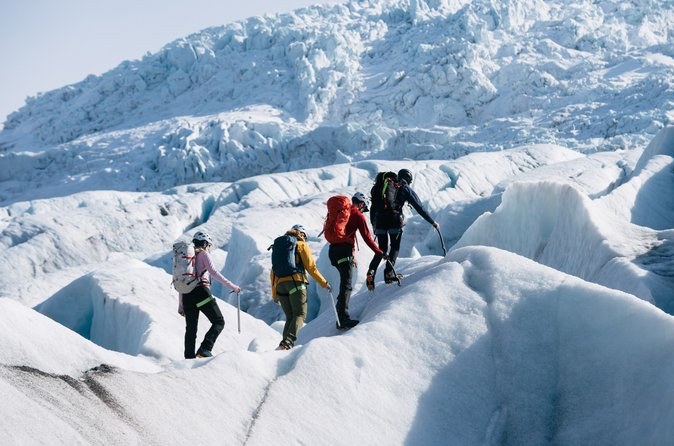
What summer does not give you is a natural ice cave. Book a glacier hike instead: the hikes pass crevasses and ice channels, which is the nearest the season comes. Rivers can rise fast in the warmth, and the park warns that snow can fall at any time of year in the mountains.
Autumn: from September
The park counts autumn from September, when the colours turn and the rangers leave the highlands. September is the wettest month at Skaftafell, at about 190 mm. In 2026 the Austurbrekkur trail there is also shut for maintenance through the month.
October opens the cave question again. The park’s contracts with cave operators run from 1 October. In 2024 it barred entry to ice caves until 30 October because the ice was unsafe. So an October cave is possible, not promised.
Skaftafellsstofa opening hours by month
Skaftafellsstofa, the visitor centre at Skaftafell, is open every month of the year. It is where you ask about trail closures and the weather on the ice, and several tours meet beside it. Its hours follow the season.
| Months | Open |
|---|---|
| January and February | 10:00 to 17:00 |
| March to May | 09:00 to 17:00 |
| June to August | 09:00 to 19:00 |
| September and October | 09:00 to 18:00 |
| November | 09:00 to 17:00 |
| December | 10:00 to 17:00 |
Morning or afternoon departures
Most glacier days start in the morning. The Langjökull snowmobile from Reykjavík picks up between 08:00 and 08:30 for its 10:30 ride, or 10:30 to 11:00 for the 13:00 ride. The gas station at Freysnes, where one Skaftafell hike meets, opens at 09:00.
Whichever you pick, arrive 20 minutes early at the Tröll bases, which fit your gear before the start time. In winter, the earlier slot leaves more light for the drive back. In summer the light lasts, so pick the slot that suits your drive.
Asked about timing
When is ice cave season in Iceland?
Can I see an ice cave in summer?
Can I hike a glacier in winter?
What is the best month for a glacier tour?
Which month is wettest at Skaftafell?
When do the highland roads open?
Where these facts come from
The seasons, the closures and the cave notices are the national park’s own, read 23 September 2026. The rainfall, temperature and sunshine figures are the Icelandic Met Office’s monthly station means. The review months are the dates on the reviews of each tour, read on the same day.
- Seasons: access and conditions through the year (national park)
- Ice caves and glacier walks, 26 September 2024 (national park, in Icelandic)
- The Skaftafell visitor centre: hours and campsite (national park)
- Monthly precipitation, station 748 at Skaftafell (Icelandic Met Office)
- Monthly means, station 745 in Öræfi (Icelandic Met Office)
- Monthly means, station 1 at Reykjavík (Icelandic Met Office)
Next: see the month-by-month figures on the weather page, read what the fare includes, or compare every fare on Iceland Glacier Tours.